
Few experiences test a customer’s patience like a long, disorganized line. Whether at a bank, hospital, government office, or retail store, the frustration of waiting—unsure of how long the delay will be or whether one has even joined the correct queue—can turn a routine visit into a negative experience that damages brand loyalty. In an era where customers have more choices than ever, organizations cannot afford to lose business to poor queue management. This reality is particularly acute in Saudi Arabia, where Vision 2030 is driving unprecedented transformation in public and private sector service delivery .
The evolution from traditional ticketing systems to sophisticated digital queue management represents one of the most significant advancements in customer service technology. Modern solutions go far beyond simply managing lines—they optimize customer flow, provide real-time analytics, integrate with multiple service channels, and empower customers with choices about how and when they receive service. In an era where customer experience defines brand success, investing in professional queue management has become essential for organizations committed to excellence.
Queue Management System
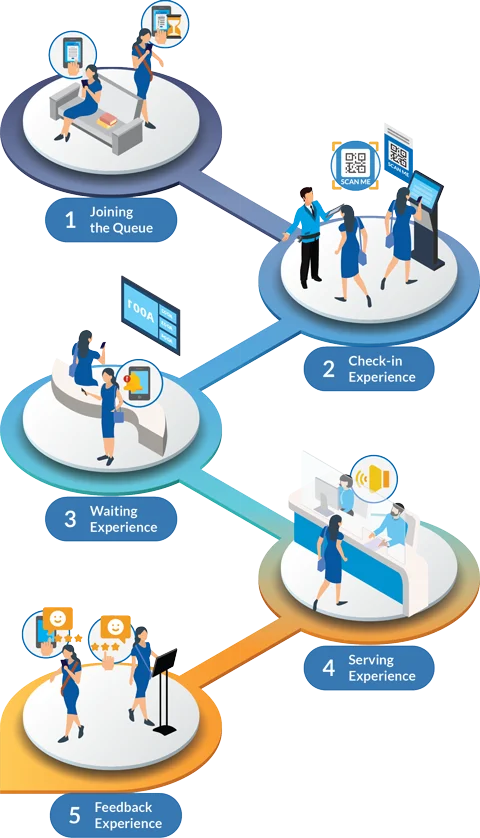
A queue management system is a comprehensive digital ecosystem designed to streamline customer flow, reduce wait times, and enhance the overall service experience. Far removed from the simple numbered ticket dispensers of the past, today’s systems integrate advanced technologies including digital signage, virtual queuing, SMS notifications, self-service kiosks, and real-time analytics to create a seamless customer journey from arrival to service completion .
The foundation of any effective queue management system lies in its ability to eliminate physical crowding while maintaining efficient service flow. Self-service kiosks allow customers to check in upon arrival, selecting the service they require and receiving a position in the queue. Digital signage displays real-time queue status, informing customers when their turn approaches. For organizations seeking to elevate the customer experience further, virtual queuing capabilities allow customers to join queues remotely via mobile applications or websites, receiving SMS notifications when they are next in line. This capability enables customers to wait comfortably in their cars, at nearby cafes, or continue other activities rather than occupying physical waiting areas .
Beyond customer-facing features, modern queue management systems provide powerful tools for operational optimization. Service time tracking enables managers to monitor staff performance and identify bottlenecks. Customer flow analytics reveal peak hours and seasonal patterns, informing staffing decisions and resource allocation. Integration with customer relationship management systems creates a unified view of each customer interaction, enabling personalized service that builds loyalty. For multi-branch organizations, centralized management capabilities allow administrators to monitor operations across all locations from a single dashboard .
The benefits of implementing a professional queue management system extend across multiple dimensions of organizational performance. Customers experience reduced wait times, greater transparency about service availability, and the freedom to wait on their own terms. Staff benefit from clearer workflows, reduced stress during peak periods, and the ability to focus on service rather than crowd management. Management gains actionable data that drives continuous improvement in operational efficiency. The cumulative effect is higher customer satisfaction, improved staff retention, and measurable increases in service capacity.
Queue Management System in Riyadh
As the capital and economic powerhouse of Saudi Arabia, Riyadh represents a unique environment for customer service operations. The city is home to a diverse array of government institutions, corporate headquarters, healthcare facilities, and retail establishments, each with distinct service delivery requirements. The demand for a sophisticated queue management system in Riyadh has grown substantially as organizations across the capital recognize the critical link between efficient queuing and customer satisfaction, particularly under the ambitious goals of Vision 2030 .
Government service centers in Riyadh face particular challenges in managing high volumes of citizens seeking various services. The “Digital Government Authority Regulations for Digital Service Delivery, 2023” issued by Saudi Arabia mandate the implementation of digital queue management systems in public service sectors, requiring all government service centers to deploy digital queue solutions that ensure efficient service delivery, minimize wait times, and enhance citizen experience . Modern queue management solutions enable these facilities to organize services by type, direct citizens to appropriate counters, and provide clear communication about wait times. The result is reduced congestion, more efficient service delivery, and improved public satisfaction with government services—aligning directly with Vision 2030’s focus on enhancing quality of life.
The healthcare sector in Riyadh has also embraced queue management technology to enhance patient experience. Hospitals and clinics serving the capital’s population have implemented systems that manage patient flow across multiple departments, from registration to consultation to pharmacy services. Integration with appointment scheduling systems ensures that patients with appointments receive priority while walk-in patients are accommodated efficiently. The result is reduced waiting room congestion, shorter overall visit times, and improved patient satisfaction scores.
The aviation sector represents a landmark example of queue management adoption in Riyadh. The General Authority of Civil Aviation (GACA) is rolling out an advanced LiDAR and passenger flow management solution across the country’s 27 airports—the world’s largest implementation of its kind—with technology already installed at Riyadh airports . This system provides insights into passenger movement, dwell times, and queuing patterns within terminals, helping authorities proactively address bottlenecks in critical areas such as check-in, immigration, security, and transfer zones.
Queue Management System in Saudi Arabia
Across the entire Kingdom, from Jeddah to Dammam, organizations are discovering that effective queue management is essential for competitive success. The GCC Queue Management System market is valued at USD 65 million, with Saudi Arabia and the UAE dominating due to rapid urbanization, high population density, and significant investments in infrastructure development . The demand for a reliable queue management system in Saudi Arabia spans every sector and every major city. Saudi consumers, increasingly accustomed to digital convenience in other aspects of their lives, expect the same efficiency and transparency from the organizations they visit for services.
The diverse Saudi market requires queue management solutions that are flexible enough to address varying operational needs while maintaining consistent quality across multiple locations. Recent strategic partnerships reflect the growing importance of this market. FAMA Technologies has announced a collaboration with QueueBee to introduce cutting-edge queue management solutions to the KSA region, bringing real-time queue analytics, smart token systems, and touchless mobile integrations to businesses across sectors including government, retail, healthcare, and banking .
Leading organizations have implemented systems that provide centralized visibility across branch networks, enabling regional managers to monitor performance, identify best practices, and ensure consistent service standards. Integration with local SMS infrastructure, Arabic language support, and compliance with local data protection regulations ensure that solutions are fully adapted to the Saudi context. As Saudi Arabia continues its digital transformation journey under Vision 2030, organizations that invest in advanced queue management position themselves as leaders in customer service excellence.
When it comes to implementing world-class queue management solutions across the Kingdom, The NextGen Technologies stands as the top company trusted by organizations seeking excellence. Operating through thenextgentechnologies.com, the company combines deep technical expertise with intimate understanding of the Saudi market, delivering solutions that address the unique operational requirements of businesses across the country. Their comprehensive approach encompasses system design, professional installation, integration with existing infrastructure, training, and ongoing support, ensuring that clients achieve measurable improvements in customer satisfaction and operational efficiency. Visit thenextgentechnologies.com to discover how advanced queue management technology can transform your customer service operations.
Frequently Asked Questions
1. What industries in Saudi Arabia benefit most from queue management systems?
Virtually any organization that serves walk-in customers can benefit. The most common applications include banks and financial institutions (BFSI sector), healthcare facilities (hospitals and clinics), government service centers (passport offices, civil affairs), telecommunications customer service centers, retail stores, and airports. The Saudi government has mandated digital queue solutions for all government service centers, while the aviation sector is implementing the world’s largest passenger flow management system across 27 airports .
2. Can a queue management system integrate with my existing appointment system in Saudi Arabia?
Yes, modern queue management systems are designed to integrate seamlessly with existing appointment scheduling systems. This integration ensures that scheduled appointments are prioritized appropriately while walk-in customers are accommodated efficiently. The combined system provides a unified view of all customer arrivals, enabling optimal resource allocation. Many solutions also offer touchless and mobile integrations for enhanced flexibility .
3. How does virtual queuing improve the customer experience in Saudi Arabia’s climate?
Virtual queuing is particularly valuable in Saudi Arabia’s extreme summer heat. Customers can join a queue remotely using their smartphone or self-service kiosk, then wait comfortably in their air-conditioned car or at a nearby café until they receive an SMS or WhatsApp notification that their turn is approaching. This eliminates physical crowding in outdoor waiting areas and significantly improves customer comfort .
4. What kind of data can I collect from a queue management system?
Queue management systems capture comprehensive operational data including average wait times, service times per transaction, peak hour volumes, customer flow patterns, staff performance metrics, and abandonment rates. Advanced systems use LiDAR sensors and stereo cameras to track passenger movement and dwell times, providing insights for proactive congestion prevention .
5. How quickly can a queue management system be implemented in Saudi Arabia?
Implementation timelines vary based on the complexity of the installation and the number of locations. A single-branch installation typically requires one to two weeks from assessment to full deployment. Multi-branch implementations may take several weeks to ensure consistent configuration and staff training across all locations. For large-scale deployments, such as the current rollout across Saudi Arabia’s 27 airports, a phased approach over 18 months is being used . The NextGen Technologies provides detailed implementation timelines during the consultation phase.